Author:DavisDate:2026-7-23
Expert Reminder: Waterproofing, Moisture-proofing, and Heat Prevention Are Key; Regular Inspections Are Essential
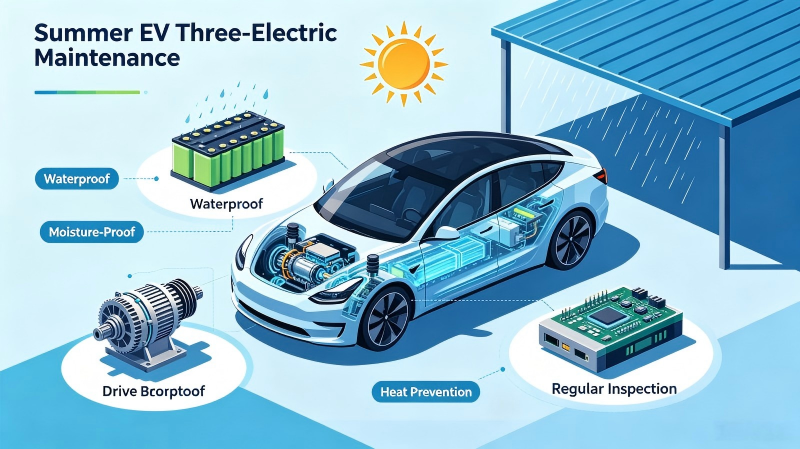
As high temperatures, torrential rain, and humid air alternate throughout the summer, they not only inconvenience travel but also pose a serious test for the core “three-electric system” of electric vehicles — the battery, motor, and electronic control system. How can you scientifically maintain your car in such weather to extend the life of its key components and ensure driving safety? Drawing on professional advice from various new energy vehicle after-sales service centers, here is a summer maintenance guide.
-6515653.png "Summer Maintenance Guide for EV Three-Electric Systems (1).png")
Battery: Avoid Sun Exposure and Water Ingress; Shallow Charging and Discharging Is Healthier
The traction battery is the most expensive part of an electric vehicle and is also the most sensitive to temperature and humidity. Mr. Li, an after-sales service engineer, advises that the first step in summer battery care is to “cool it down”: avoid parking the vehicle under direct sunlight for extended periods whenever possible, and choose underground parking or shaded charging stations for charging. High-temperature operation inherently accelerates battery degradation. If you use high-power fast charging immediately after the vehicle has been baking in the sun, the battery thermal management system will be overloaded, potentially triggering power limitation protection. Doing this over the long term will further affect battery lifespan.
In a damp and rainy environment, waterproofing and moisture-proofing are another key priority. Although the current national standard requires the battery pack to meet IP67 dust and water resistance, water on the charging port or the charging connector can easily cause a short circuit or electric shock risk. Before charging outdoors, owners must check and wipe any water from the charging port and the charging gun to ensure they are completely dry before plugging in. On rainy days, try to use charging stations with canopies. If no shelter is available, you can temporarily wrap the connector with a dry towel for protection. When driving through water, although EVs have better short-term wading capability than gasoline vehicles, you should still avoid driving through or being immersed in deep water for extended periods to prevent accidental water ingress through aged battery pack seals.
-9441862.png "Summer Maintenance Guide for EV Three-Electric Systems (2).png")
Furthermore, “shallow charging and shallow discharging” is more suitable for summer use. For non-long-distance trips, it is advisable to keep the battery charge between 30% and 80%, charging as needed without always aiming for a full charge. If your vehicle has a charge limit setting function, you can temporarily set the threshold to around 90%. This relieves internal pressure on the battery and helps extend its cycle life.
Motor: Pay Attention to Heat Dissipation and Wading; Avoid Abusive Driving
The drive motor itself is structurally robust and largely maintenance-free, but it still faces two major risks in a hot and humid summer: overheating and water ingress. After high-load operation, the motor’s temperature becomes extremely high, and it relies on coolant circulation to dissipate heat. Owners should regularly check that the motor coolant level is within the normal range. If you notice an abnormal drop in coolant level or a high-temperature warning, stop the vehicle immediately for inspection. After continuous uphill driving or high-speed cruising, avoid switching off the vehicle right away. Let the cooling system continue working for a short while to help the motor cool down smoothly.
At the same time, while the motor has a high waterproof rating, this does not mean you can drive it like a submarine. When the wading depth exceeds half the wheel height, the pressure on the motor and its high-voltage wiring harness connectors increases dramatically. Once there is even a tiny seal damage, moisture may invade the motor interior, leading to insulation failure. After wading, pay attention to any abnormal whining or jerking. If you notice anything unusual, go to a service center promptly to check whether the reduction gear oil has emulsified.
-7898283.png "Summer Maintenance Guide for EV Three-Electric Systems (3).png")
Electronic Control System: Moisture-proofing Is the Top Priority; Never Clean Blindly
The electronic control system serves as the “brain” of an electric vehicle, integrating precision electronic components such as the inverter, on-board charger, and DC/DC converter. It is extremely sensitive to moisture and heat. In summer, the large temperature difference between the inside and outside of the cabin can cause condensation. If a blocked air-conditioning drain leads to floor water accumulation, moisture can invade the control module connectors located under the seats or within the floor wiring harnesses, causing signal errors or even insulation faults. Therefore, keep the interior dry and choose well-ventilated, dry places for parking whenever possible.
Many owners like to clean the front compartment themselves. Aftersales personnel offer a special reminder: Never use a high-pressure water gun to directly wash the front compartment. Although the electronic control units and high-voltage wiring are designed with waterproofing, the high-pressure water stream can still breach the seals, leading to oxidation and short circuits in the connectors. The correct cleaning method is to wipe with a damp cloth. Also, regularly check the high-voltage wiring for signs of aging, cracking, or looseness, and if any issues are found, have them replaced by a professional.
Finally, it is recommended that owners arrange a specialized inspection of the three-electric system at the beginning and end of each summer, focusing on battery pack airtightness, coolant freezing and boiling points, and the insulation resistance of high-voltage connectors, to prevent problems before they arise. Only by properly maintaining the “three-electric” system can an electric vehicle truly withstand the heat and humidity and safely endure the summer.
↓Next [ Study the Spirit of the Party Constitution, Remain True to Our Original Aspiration and Forge Ahead ]