Author:NickyDate:2026-11-9
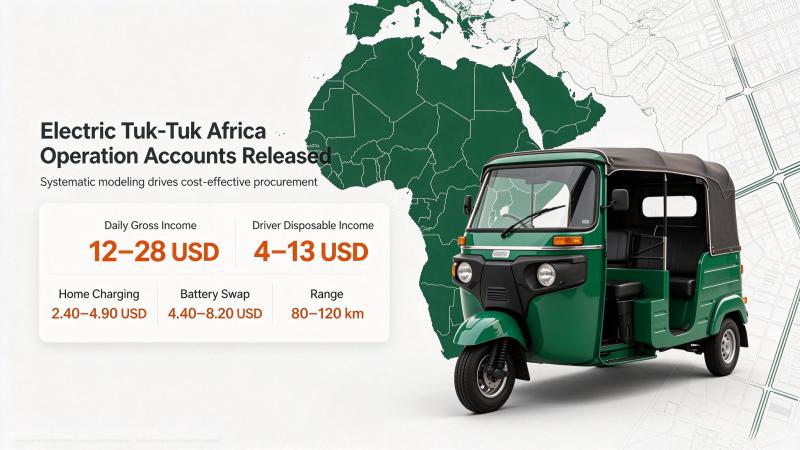
The electric tuk-tuk passenger transport market in Africa is sending clearer commercial signals. According to the latest operating assessment data, electric tuk-tuks used for passenger services in selected cities in East and West Africa are planned around a daily gross revenue range of US$12–28**. After deducting energy, maintenance, road parking and installment rent costs, drivers’ conservative disposable income can be estimated at **US$4–13 per day. For buyers watching the overseas electric mobility sector, the significance of this “operating ledger” is not to provide a uniform return promise, but to highlight a key shift: the competitiveness of electric tuk-tuks increasingly depends on how well the vehicle matches the operating system around it, not just on the vehicle itself.
Regionally, core areas of large cities such as Nairobi, Lagos and Accra can reach gross revenue of US$18–28 per day under 10–12 working hours, mainly supported by dense passenger flows and short-distance orders. Secondary towns and suburban routes, under 8–10 working hours, show gross revenue of US$12–18; order frequency is lower, but average trip distance is longer. Differences between markets are significant. Fare regulation, traffic restrictions, rainy seasons, competitive intensity and exchange-rate fluctuations can all change final results.
What really widens the gap in drivers’ take-home income is the charging model and vehicle ownership structure. Under home charging, direct daily operating costs can be controlled at US$2.40–4.90; battery leasing or swapping models raise this to US$4.40–8.20. Battery swapping trades higher daytime vehicle utilization, with a 3–5 minute energy replenishment time, for higher costs. Buyers must also assess swap-station coverage, queuing time, service pricing and the risk of being locked into a single network. At the vehicle level, full-load operating range is about 80–120 km; charging takes 8–10 hours, while swapping compresses this to 3–5 minutes. Actual performance depends on model, load, terrain and temperature.
-5270216.jpg "生成多语言图片 (1).jpg")
Structural drivers in overseas markets are accelerating this sector. Persistently high international fuel prices are amplifying the operating-cost disadvantage of traditional fuel-powered tuk-tuks, and demand for new-energy tuk-tuks in Southeast Asia, Africa and the Middle East is becoming more urgent. Policy signals are also tilting toward electrification: Bangkok, Thailand, plans to ban internal-combustion-engine tuk-tuks from the inner city and open road access only to compliant electric models. At the same time, China’s supply chain is responding faster. A electric tuk-tuk manufacturer in Zhenjiang, Jiangsu, achieved full production and full sales within less than a year of resuming production; overall sales in the first half of 2026 reached RMB 180 million, up 87% year on year, with overseas orders fully booked. The Fengxian industrial cluster, relying on a “half-hour procurement circle,” can source 95% of components locally, and customized models—such as solar-charging versions and three-row configurations adapted to complex road conditions—continue to enter Southeast Asia, Africa and South America.
Yet beneath strong demand, the divergence in selection logic deserves equal attention. The assessment clearly distinguishes three calibers: gross revenue, vehicle-level operating cash surplus, and driver disposable income. In one vehicle calculation scenario, the surplus may be higher than US$13 per day, but after deducting installments, rent, insurance, licensing, battery reserves and downtime losses, conservative disposable income should still return to the reference range of US$4–13. This means that importers, dealers and fleet operators who compare only the landed price of the vehicle may significantly underestimate how charging infrastructure, spare-parts supply and after-sales networks drag down actual operating efficiency.
For tuk-tuk sales companies, the entry point for this round of overseas opportunities is shifting from “selling vehicles” to “delivering an operable capacity system.” Beyond vehicle specifications, the real cost boundary of procurement decisions is jointly shaped by the compatibility of charging and swapping solutions, local licensing and road-access compliance, spare-parts response radius, and the matching of financing, installment and rental structures. Suppliers that can help customers incorporate these variables into advance calculations are more likely to build sustainable channel trust in incremental markets in Africa, Southeast Asia and the Middle East.