Author:NickyDate:2026-11-28
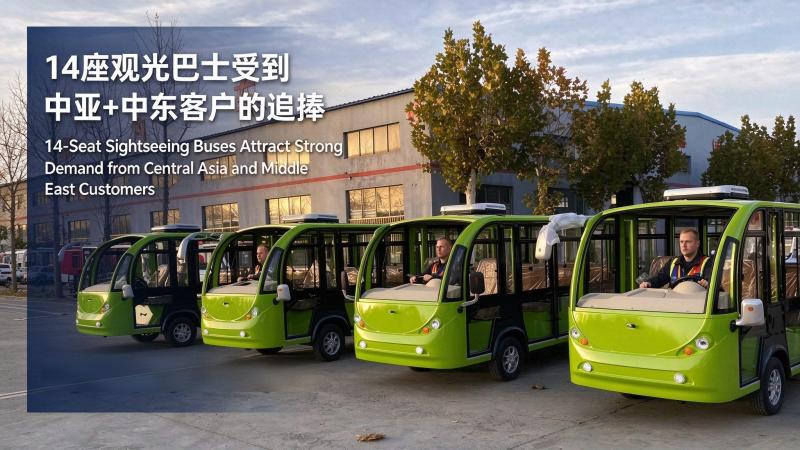
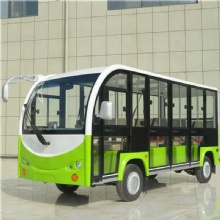
Recently, China’s exports of new energy special-purpose vehicles have maintained strong growth momentum. Among them, 14-seat electric sightseeing buses have stood out with bulk orders secured in Central Asian and Middle Eastern markets, emerging as a highly sought-after model for scenic spot shuttles, industrial park commuting, and resort operations. Industry data shows that China’s total export volume of electric sightseeing vehicles reached 32,100 units in 2025, a year-on-year increase of 19.7%, covering 110 countries and regions worldwide. The growth rate in the Middle East and Central Asia has been notably higher than the industry average.
Steady Growth in Orders and Rising Regional Market Recognition
In terms of export structure, 14-seat sightseeing buses, with their moderate passenger capacity, flexible body dimensions and high operational economy, have become the mainstream procurement model for the five Central Asian countries and Gulf states. In core markets such as the UAE, Saudi Arabia, Kazakhstan and Uzbekistan, tourist attractions, high-end resorts, large industrial parks and university towns are accelerating the replacement of traditional fuel-powered shuttle vehicles, and the procurement share of fully enclosed electric sightseeing buses is increasing year by year.
Feedback from multiple local vehicle manufacturers in Shandong Province shows that since the beginning of this year, inquiries from the Middle East and Central Asia have increased by more than 40% year-on-year, and the delivery cycle for 14-seat enclosed models has been scheduled to the first quarter of next year. Customers generally opt for lithium iron phosphate (LiFePO4) battery configurations, high-power heating and cooling air conditioning, and right-hand drive customization to adapt to the local high-temperature climate and road traffic regulations. Countries like Saudi Arabia have incorporated electric shuttle vehicles into the green transportation system of Vision 2030, with a clear trend of centralized procurement by hotel groups and municipal departments.
Customized Adaptation Addresses Regional Market Pain Points
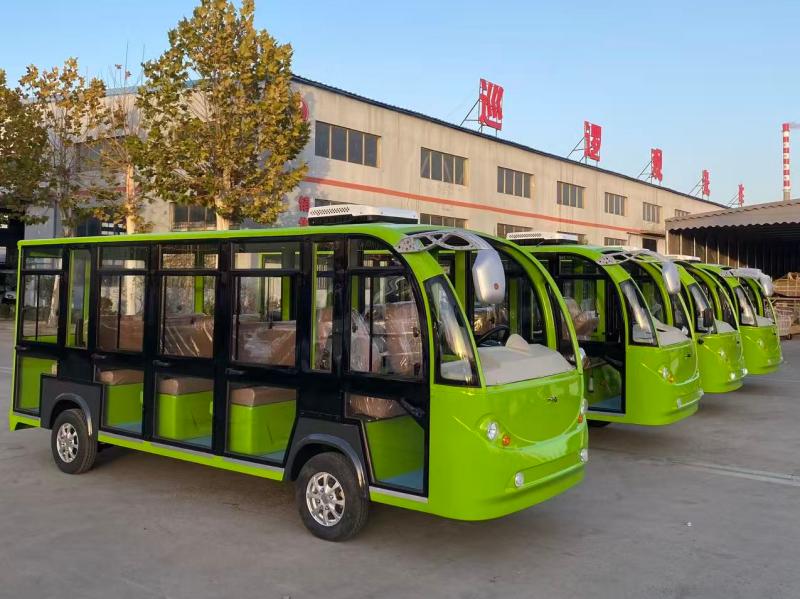
The rapid rise of 14-seat sightseeing buses in Central Asian and Middle Eastern markets lies in their targeted product adaptation capabilities. In response to the characteristics of high summer temperatures and heavy sand dust in the Middle East, export models are generally upgraded with dual air-conditioning refrigeration systems, dust-proof sealed body structures and high-torque motors to ensure stable continuous operation in high-temperature environments. For the mountainous terrain and high climbing demands in Central Asia, some models are equipped with 11kW AC asynchronous motors and reinforced rear axles, with significantly enhanced climbing capacity and a cruising range of over 150 kilometers.
Meanwhile, body painting, seat layout, door structure and even LOGO markings can be customized on demand. Differentiated designs such as U-shaped seat layouts and detachable transparent doors are highly favored by overseas customers. The mature supply system of both left-hand and right-hand drive versions also enables the product to cover markets in left-hand drive Central Asian countries and some right-hand drive Middle Eastern countries simultaneously, greatly lowering the procurement threshold for customers.
Dual Drivers: Green Transition and Tourism Recovery
Industry analysts point out that the growing demand for 14-seat sightseeing buses in Central Asian and Middle Eastern markets is driven by two core forces. On the one hand, Saudi Arabia's Vision 2030, the UAE's 2050 Carbon Neutrality Strategy and the green development plans of multiple Central Asian countries are promoting the electrification transition of public service and commercial operation vehicles. Low-speed electric sightseeing vehicles have become one of the fastest-implementing categories due to their closed operation scenarios, convenient charging and short return on investment cycle.
On the other hand, the sustained recovery of the global tourism industry has driven a steady rebound in tourist reception at luxury resorts in the Middle East and natural scenic spots in Central Asia, releasing rapidly growing demand for short-distance passenger transport such as intra-scenic shuttles, hotel transfers and old town tours. The 14-seat model can meet the passenger demand of medium-sized teams while flexibly navigating scenic roads and internal park roads, striking a good balance between operational efficiency and riding experience.
-9223921.jpg "1 (3).jpg")
Industrial Cluster Advantages Underpin Export Growth
China has formed a complete industrial chain cluster in the field of electric sightseeing vehicles. Regions such as Shandong, Jiangsu and Henan gather a large number of complete vehicle and component enterprises, with independent and controllable manufacturing covering batteries, motors, chassis and bodywork, boasting prominent cost advantages and delivery capacity. With the increasing recognition in overseas markets, leading enterprises are gradually upgrading from simple product export to a "product + service" model, laying out spare parts warehouses and after-sales outlets in key markets to further consolidate market share.
It is forecast that the global electric sightseeing bus market will grow from 1.33 billion US dollars in 2025 to 2.66 billion US dollars in 2032, with a compound annual growth rate of 10.5%. Among them, the growth rate in the Middle East and Central Asia will be higher than the global average. Backed by its mature manufacturing system and flexible customization capabilities, China's 14-seat sightseeing buses are expected to further expand their market advantages in this round of global green transportation upgrading.